Thursday, May 2, 2024

Executive Functioning and Giftedness: Part 2

by: Erin Peace, LCSW, RPT
School Counselor


Part 1: Executive Functioning As a Spectrum of Skills


In Part 1 of this blog series on giftedness and executive functioning, we explored the dimensions of executive functioning and reviewed how to self-assess the various domains of executive functioning.

Many gifted and twice-exceptional students require executive functioning support for a variety of reasons, including a difference in their prefrontal cortex development compared to same-age peers. Many times, gifted students haven’t needed to practice study skills or time management skills due to completing material in class or finishing homework more quickly than their peers. These students can also complete material so quickly that they didn’t learn skills around planning for larger projects.

The domains of executive functioning can be found on a spectrum, and each students’ abilities vary both among the population and within the individual. In this post, you will find information on how to help your student strengthen two domains of executive functioning: organization and time management.


Collaborate: Goal-Plan-Do-Review for Organization

After an individual has identified their executive functioning strengths and weaknesses using a self-assessment (See Part 1 for more information), students should then be invited to collaborate on solutions together. Use the Goal-Plan -Do-Review approach to help students build their organization/planning skill:


    1. Goal: Before beginning, use a “team huddle” to identify what the student wants to accomplish (i.e. write a paragraph for my English essay)
    2. Plan: How will I accomplish this goal? What materials do I need? Who can help me accomplish this goal? Turn the steps into a written list or checklist
    3. Do: Implement the plan
    4. Review: Reflect on how well the plan worked, and what could be improved upon next time

Over time, adults should phase out supervision of the plan and implementation.


Time Management

Students benefit from finding a homework/assignment planner that works for them. Although some students prefer paper planners, others prefer using apps or calendar functions. Have students try out different methods like a science experiment, reviewing what worked and what needs to be tweaked. When students are able to find all of their assignments in one place, along with the due date and a section for notes, they increase their ability to organize materials and prioritize assignments.

Visual timers can be a great resource for students, especially those who experience “time-blindness.” This timer can be used to set five minute increments of work time, and five minute breaks, before building up to longer amounts of time as stamina builds. Apps such as Routinery and Tiimo allow students to set routines with visual reminders and timers.



Although many students struggle with these skills at first, with practice and scaffolding they can build their confidence and sense of self-mastery, until they no longer need adult intervention and supervision.


Wednesday, January 10, 2024

Executive Functioning and Giftedness


by: Erin Peace, LCSW, RPT
School Counselor


As we settle back into our routine for the school year, many of us emphasize setting resolutions for the new year. These resolutions or intentions can help us accomplish goals when we identify tasks that are meaningful and realistic; how can we encourage our gifted students to set and work towards goals that are meaningful to them?

Executive Functioning and Giftedness

Executive functioning refers to a neurological set of skills that help individuals regulate their emotions, and thereby their actions. These skills are needed in order to plan, organize, and follow-through on activities, and we can think of the executive functioning center of our brain as the concert conductor or air traffic controller of our actions.

Due to the asynchronous development of the brain among the gifted population, we see an extreme range of executive functioning abilities both among and within our students, and many of our students need scaffolding to help build these skills, especially in relation to non-preferred tasks. Due to their cognitive abilities, students may not have had to outline larger projects or executive time management as their same-age peers during elementary school, and they are forced to learn these skills in middle school or high school.


Collaboration with Gifted Students

In order to increase a student’s buy-in to increase these skills, providing education about the gifted brain and fostering collaboration with students can increase the motivation and willingness to pursue goals that are either important to them while increasing their sense of self-efficacy.

A collaborative conversation should be had with the student about a goal, and the adult can then help the student identify the steps into a checklist that the student can visualize and use daily. After using a system, we should then work with the student to evaluate the process and identify which strategies worked, and which need to be tweaked in order to be successful. Eventually, these systems should be modified to reduce adult supervision and intervention, which increases a student’s sense of self-efficacy and reduces the risk of enabling.


Task Initiation

Many times, our gifted students have an outstanding ability to focus and work on things that they find interesting or exciting. With larger or less-preferred tasks, we can help increase our student’s motivation by front-loading the work with enjoyable tasks, as well as setting a firm start time for the work. Short breaks can be interspersed with frequent acknowledgment of the student’s effort and progress. A solutions-focused approach can also be used to explore with the student about things they don’t procrastinate on, and what conditions allow for this increased sense of motivation and self-esteem. In a future blog post, we’ll explore how to help gifted students strengthen their time management skills in order to pursue these goals.

Where to begin? Start with an Executive Functioning Self-Assessment from Smart but Scattered HERE.


Book Resources: Smart but Scattered, and Smart but Scattered Teens.

Image Source for EF graphic: Focus Therapy
Image Source for Homework Planner: Smart But Scattered


Tuesday, September 26, 2023

Nurturing Young Minds: A Parent’s Guide to Promoting Mental Health


Image Source

by: Erin Peace, LCSW, RPT
School Counselor

Over the last few years, educators and parents have identified a need for increased mental health support for children. These needs became especially clear after the transitions and stressors related to the start of the pandemic, and in April U.S. Surgeon General Vivek Murthy stated that “kids’ and adolescents’ declining mental health is the crisis of our time.” A JAMA meta-analysis of over 80,000 youths globally done in 2021 showed about 1 in 4 adolescents demonstrated clinically significant signs of depression, and about 1 in 5 adolescents demonstrated clinically significant signs of anxiety. 


Parents and educators can partner to provide students with the tools needed to identify and address stress, and these shifts can start with us as the adults modeling healthy coping skills to students. Here are some tips for parents on how to have meaningful conversations about mental health with your children.

  • Create a Safe and Open Environment: Begin by fostering an atmosphere where your child feels comfortable discussing their thoughts and feelings. Let them know that their emotions are valid and that you're there to listen without judgment. Encourage them to express themselves in their own time and way.


  • Lead by Example: Children learn from observing their parents. Demonstrate healthy coping mechanisms and stress management strategies in your daily life. When they see you prioritize your mental well-being, they're more likely to do the same.


  • Normalize Emotions: Teach your child that it's okay to experience a wide range of emotions, and that these feelings are a natural part of life. Use everyday situations as opportunities to discuss emotions and how to deal with them effectively.


  • Active Listening: When your child wants to talk, be an active listener. This means giving them your full attention, maintaining eye contact, and asking open-ended questions to encourage them to share more. Avoid interrupting or immediately offering solutions; sometimes, they just need someone to listen.


  • Empower Problem-Solving Skills: Instead of solving their problems for them, guide your child in finding solutions. This helps them develop critical thinking skills and boosts their self-confidence in handling challenging situations.


  • Teach Stress-Reduction Techniques: Introduce relaxation techniques like deep breathing, mindfulness, or even physical activities such as yoga. These tools can help your child manage stress and anxiety effectively.


  • Stay Informed Together: Keep yourselves informed about mental health together. Read age-appropriate books or articles, watch educational videos, or attend workshops that focus on mental health topics. This shared learning experience can spark valuable discussions.


  • Seek Professional Help When Needed: Sometimes, children may need professional guidance to navigate their mental health challenges. Be open to the idea of seeking help from a therapist or counselor when necessary. Explain that it's a positive step towards getting the support they need.


  • Celebrate Small Wins: Acknowledge and celebrate your child's achievements, no matter how small they may seem. This boosts their self-esteem and encourages them to keep working towards positive mental health.


  • Consistency is Key: Make these conversations a regular part of your family life. Don't wait for a crisis to discuss mental health. Consistency will help break down the stigma and create an ongoing dialogue.


Promoting mental health is an ongoing journey, and it's okay to seek guidance from professionals if you're unsure how to approach certain situations. By fostering a safe and open environment to talk about mental health, you can create a lasting impact on your child's mental well-being, ensuring they grow up with tools to be resilient and emotionally intelligent individuals.

Saturday, April 1, 2023

Shakespeare Fest 2023

 On Friday, March 31st ACE Academy enjoyed a day of sun, fun, and Shakespeare!


We began the day with fun activities in our Lower and Upper School classes. Then we went outside to have a festival that included crafts, feats of strength, music, costumes, and more! 

Face Painting by Kiwi's Party -- Kiwisparty.com


After lunch we enjoyed performances and Q&A sessions from The Baron's Men who performed scenes from A Winter's Tale and a group from UT Austin who performed scenes from A Midsummer Night's Dream. Our students also performed the songs they learned with Robin Grace in the morning.


UT students performing


Friday, March 31, 2023

Robotics in Fourth Grade STEM


Last week our fourth grade students dove into an introduction of A.I. and how we use it in daily life. This week we began constructing our first robotic driving base and learning the proper code functions. As we progress our learners will begin to program their robots with a fundamental A.I. with the ability to run an obstacle course. What a fun and hard working group of learners!


Friday, March 10, 2023

Happy (early) Pi Day!

Students in our 8th grade Geometry class have just finished a unit on circles - so what better way to celebrate (early) Pi Day than by measuring and eating real pie?

Ensuring that each student received an equal share required the use of a few measurement tools and a keen eye for detail. They used a compass and protractor - measurement tools of choice of the ancients - to construct the center of each pie. Then they split it into equal size sectors, also known as perfect slices of pie!


Here is a problem the group completed (from Open Up Resources). Can you solve it?

Wendell really likes pie and has offered to pay twice the price for a slice of pie that is guaranteed to contain at least 15 square inches of pie. 

-- What is the degree measure of the smallest sector of an 8 inch round pie that will satisfy Wendall's cravings?


National History Day


National History Day (NHD) is 
a year-long program focused on historical research, interpretation and creative expression for 6th- to 12th-grade students. By participating in NHD, students endeavor to become writers, filmmakers, web designers, playwrights, and artists as they seek to create unique contemporary expressions of history. In the ACE Academy Middle School history classes, we introduce NHD to the students with the goal of fostering a more complex appreciation of history and developing the requisite executive functioning skills conducive to the successful completion of long-term objectives, products, and projects.


On March 8, 2023, our 6th and 7th grade students shared the results of their historical research and product development. The students presented the museum exhibits, websites, documentaries, and papers that they had created from their research into the annual theme: Frontiers in History. Their topics ranged from civil rights to scientific advances to alternative music, and their presentations were conducted before an audience of parents, teachers, and fellow students.


Thursday, March 9, 2023

Global Fest 2023

The ACE Community had a wonderful time celebrating our cultural heritages at Global Fest on Saturday. We enjoyed delicious food, engaging musical and dance performances, and spending time together. Thank you to all of our staff and parents who made this event a huge success! A extra special thank you to our No Place for Hate student committee who put in a lot of time and effort helping support the planning, set up, and clean up for the event. 

Students from Austin Chinese American Network


Wednesday, March 8, 2023

Giftedness and Perfectionism

 By Erin Peace, LCSW, RPT: ACE Academy School Counselor


What is perfectionism?
The American Psychology Association defines perfectionism as “the tendency to demand of others or of oneself an extremely high or even flawless level of performance.” Due to gifted students’ internal and external pressures related to their high abilities, perfectionism shows up among many of our students. It can be helpful to delineate when perfectionism can be a helpful, driving motivation, or serve as a debilitating barrier that prevents students from attempting difficult tasks. 


Perfectionism vs. Healthy Striving


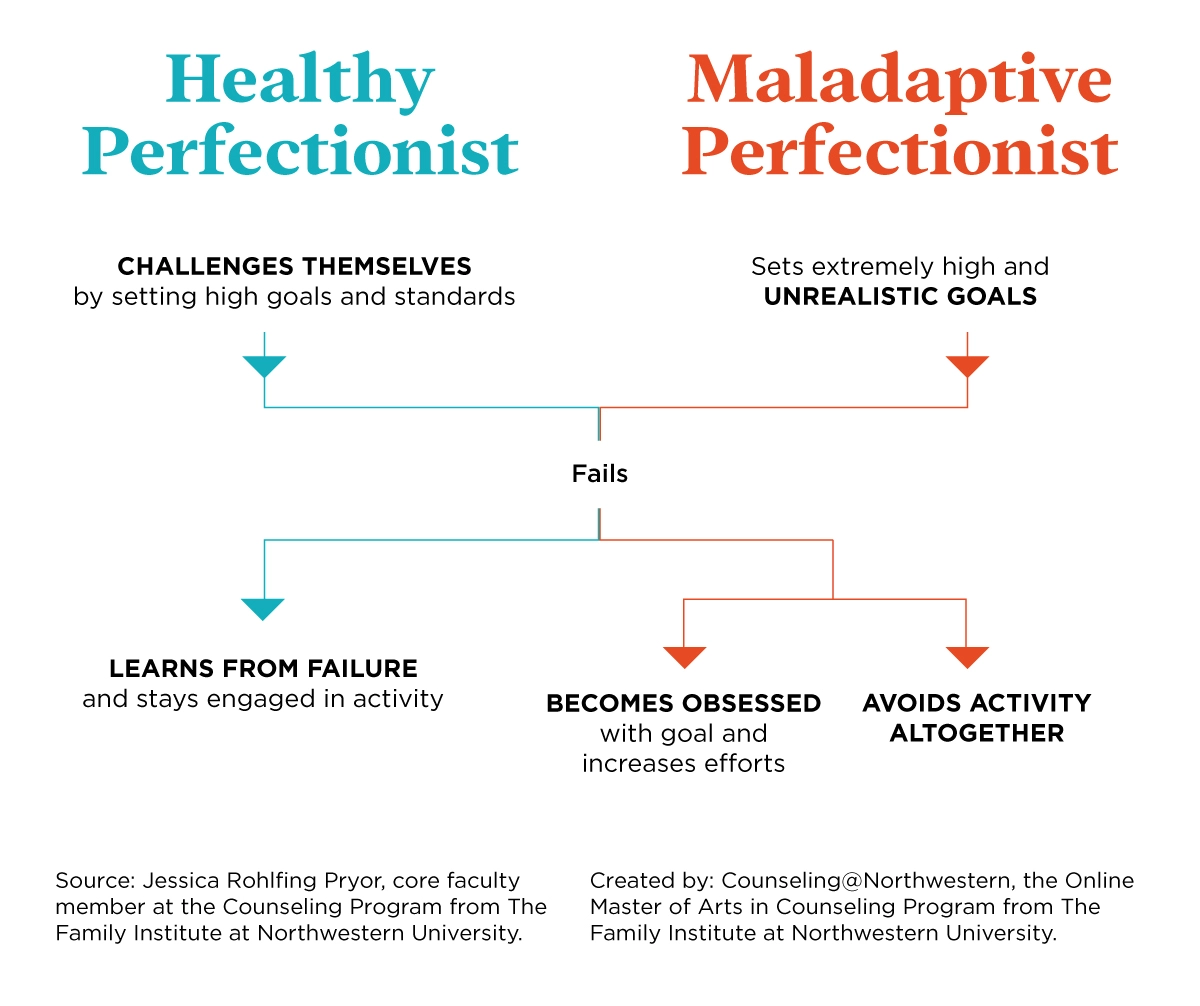
While perfectionism can lead to avoidance or low self-esteem, healthy striving for excellence encourages students to set high yet realistic goals. By pushing yourself out of your comfort zone, you can feel proud when you try new things or make mistakes in order to learn. 


Maladaptive perfectionism, on the other hand, both stems from low self-esteem and contributes to the cycle of low self-esteem. When a student sets a standard for flawless performance and is unable to meet those standards, they often experience either avoidance of the material or obsession related to external validation instead of intrinsic motivation. This video, which is developed for younger students, helps define perfectionism and give concrete examples. 


Healthy Striving

Perfectionism


Assessing for Perfectionism

Individuals can encounter perfectionism in certain domains and not others: for example, one person may experience unrealistically high standards in math or history, while others may only face this while playing sports or developing friendships. In order to help a student address these beliefs and actions, you can help them identify their triggers to then set goals.

For Lower School Students: This worksheet from School Counseling Success can help students identify their perfectionistic tendencies, while also exploring alternatives for healthy striving. 


For Upper School Students: This informal assessment breaks down perfectionism into different categories. 


Resources for Parents

Both Hoagies’ Gifted Education and the Davidson Institute provide parent resources for supporting your students’ growth mindset skills. In a future blog post, I will identify specific strategies you can use to address maladaptive perfectionistic tendencies and support your students’ self-esteem.


Friday, February 24, 2023

Focus on STEM - Science Fair Winners

ACE Upper School students worked so hard on their science fair projects this year. They had the chance to share and explain their research through the end of January. The photo below shows some of our Science Fair Winners. These students earned high points for clearly stating and explaining their purpose, hypothesis, variables, results, and conclusions on their board and in presenting to others. 


Participating in Science Fair is a great way to put into practice all the elements of the scientific method, as well as building their executive functioning skills for long term planning and public speaking skills. We are so proud of all the hard work all of our Upper Schoolers did during Science Fair this year!


Monday, February 20, 2023

Repurposing and Creativity -- Flower Presses in Jewelry Making


What can you make with scrap wood from an old bookshelf? The possibilities are endless when you engage your creativity muscles.

ACE Upper School students in our Jewelry Making elective class taught by Tara Barron transformed that scrap wood into flower presses. They plan to make resin jewelry pieces with pressed flowers inside, so they began from scratch and sawed, sanded, and drilled their presses themselves. 

We can't wait to see their amazing resin creations!


Friday, February 10, 2023

SEL: Valentine's Day and Self-Compassion

By Erin Peace, LCSW, RPT: ACE Academy School Counselor

As Valentine's Day approaches, I like to talk to kiddos about self-compassion and loving ourselves, versus focusing solely on external validation for love and acceptance. Many of our students have difficulty practicing the art of self-compassion, and explicit focus on this during Valentine's week can be helpful timing. 

HERE is a self-compassion exercise you can try. 


At its core, self-compassion involves 3 components: 

1) mindfulness: being aware of the thoughts and emotions arising without judgement

2) self-kindness: extending the same kindness to yourself that you would to a friend

3) common humanity: recognizing that to be human is to make mistakes and learn from the mistakes


In order to help students feel proud of their strengths, and also practice accepting their weaknesses, you can have students write kindness letters to themselves, or decorate portraits identifying their self-compassionate parts and self-critical parts. 

Here is a cute photos of the 1st/2nd graders decorating their self-compassion gingerbread people today. This was after we wrote down their self-critical thoughts on toilet paper to be flushed down the toilet! They obviously loved that part.


Thursday, February 9, 2023

ACE Engage Service Learning


Every upper schooler this year has participated in several service projects from the ground up. They have worked to identify a need in the community, research about it, and volunteered their time. They helped in various areas including spreading literacy, helping the environment, and serving those in need. While collaborating with each other and members of the community, they built relationship skills and social awareness. 

Seventh graders, along with Ms. Srinivasan and Ms. Harris, chose literacy as their focus for service this year. In the first semester, they adopted a local Little Free Library and ran a book drive to restock it.

In February, they chose to volunteer at BookSpring, a local nonprofit that focuses on distributing books to children.  They spent an afternoon helping to sort and organize books to share their love of literacy with other children in Austin. 


Students also spent time giving back to the local community by doing some clean up in a local park. We want to help Austin shine!


Friday, January 27, 2023

Found Poetry from "I Have a Dream"


Last week, to honor MLK Jr., the 3/4 class did a found poetry assignment based on the "I Have a Dream" speech.

First, we watched a creative video that incorporated the audio of the "I Have a Dream" speech. Next, each student was given a copy of the speech and a highlighter pen. As a first step, I asked them to use their highlighter to flag any words or phrases they found powerful, moving, or interesting. Next, I asked them to edit their list by cutting their word list in half and finally down to only ten words. At this point, I asked them to take the ten words, read them, and determine a theme or emotion they wanted to communicate in their poem. The final step was to write their poem with their ten words, adding any word or phrases to make the poem flow smoothly or make sense.

They were enthusiastic about this project from the start. In the end, they took the speech's message to heart and created a beautiful reflection in their creative poetry piece.


Tuesday, January 24, 2023

Happy New Year from our Mandarin Class

Happy New Year!

The foreign language department at ACE enjoys sharing cultural traditions with our students in addition to helping them develop their language skills.

Ms. Bao spent time with her Upper School Mandarin classes celebrating the New Year with fun and food. They worked together to make dumplings and students also brought in other treats to share. 


Tuesday, January 17, 2023

January SEL Focus - Relationship Skills

By Erin Peace, LCSW, RPT: ACE Academy School Counselor


CASEL defines relationship skills as "The abilities to establish and maintain healthy and supportive relationships and to effectively navigate settings with diverse individuals and groups." These include the ability to communicate clearly, listen well, cooperate with others, resist inappropriate social pressure, negotiate conflict constructively, and seek and offer help when needed.

Due to the asynchronous development of our gifted kiddos, we see a huge spectrum of social skill development among all ages. These social interactions get even more complicated when a student has a diagnosis such as ADHD or Autism Spectrum Disorder, which impacts a person's ability to effectively use impulse control, regulate emotions, and see a view from another person's perspective.


Identifying Goals Related to Relationship Skills


A way to help students identify their relationship skills is by having them fill out a short social skills assessment to see which prosocial skills students are using and can work on increasing, while also identifying which antisocial skills students need to reduce in order to maintain relationships. With this information, students can then set small goals so that they're able to increase their relationship satisfaction.


Define Healthy Relationships With Your Student

Students benefit from specific instruction on what healthy relationships entail: Respect, equality, safety, and trust. I've included a graphic below from the resource Unhushed that helps break down these components:


Relationship Skill Spotlight: Conflict Resolution

I like to tell students that unless you're a robot, you will have conflict arise in any friendship or relationship. We all have different experiences, perspectives, and communication styles, so it would be unreasonable to think we would never have conflict with others. I usually break down conflict resolution using a Restorative Justice lens, and provide the following steps for resolving conflict:

  1. Identify how big the problem is (Is it a big problem or small problem? Can it be ignored?)

  2. Stop to calm down your brain and body (If you're really upset, take a break before trying to resolve the issue)

  3. Talk it out (Use "I" statements to identify how you feel and what you need. Take turns to listen to the other person's point of view)

  4. Problem-solve different solutions (What sort of compromise can be developed?)

  5. Apologize (We all make mistakes, and owning our part in the conflict is the right thing to do)

As with any SEL skill, your student's relationship skills will also depend on how you model these skills explicitly to your child.


Conflict Resolution: Video Example


Executive Functioning and Giftedness: Part 2

by: Erin Peace, LCSW, RPT School Counselor Part 1: Executive Functioning As a Spectrum of Skills In Part 1 of this blog series on giftedness...